
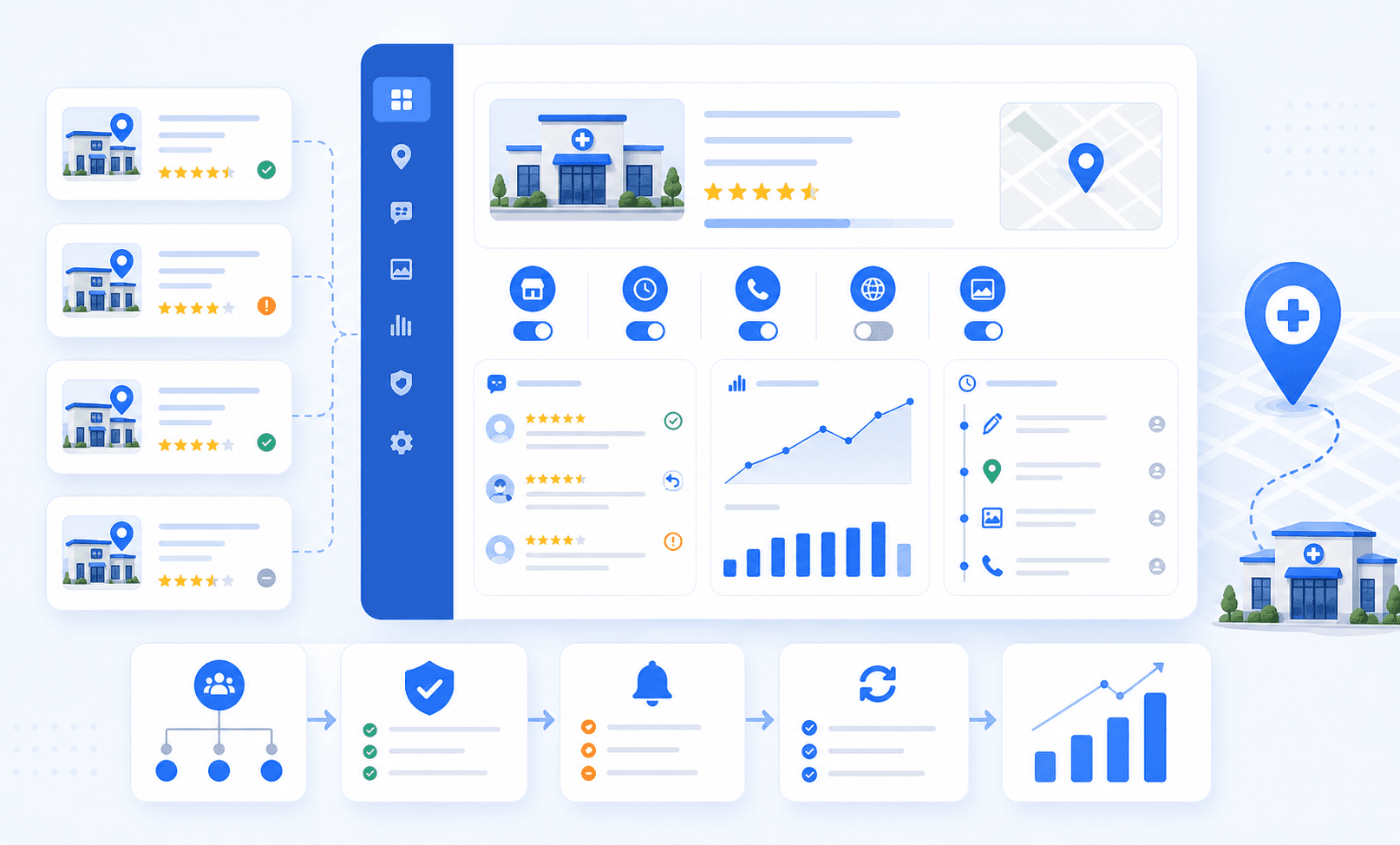
Google Maps is often the first trust checkpoint for local healthcare decisions.
If your clinic is not visible there, patients are more likely to choose the businesses that appear above you.
Google Business Profile management software is not necessary for every clinic. Some locations can manage their profiles manually for a long time without major friction. Others reach a point where change control, review response, listing oversight, and profile consistency become too messy to handle through ad hoc internal workflows.
That is where software starts to matter.
Guide overview
What you'll work through in this guide
What GBP management software should actually solve
Good software should not just give a clinic a prettier dashboard. It should reduce real operational risk around profile management.
When manual management is still enough
A clinic may not need software yet if:
When clinics usually do need software
Once several locations, managers, vendors, or support staff are interacting with profiles, inconsistency becomes much more likely.
The short version is this: clinics usually need GBP management software when profile work becomes operationally complex enough that manual control starts causing delays, missed updates, visibility drift, or avoidable risk.
If the clinic is already feeling that friction, GBP management software is the natural first place to evaluate the workflow.
What GBP management software should actually solve
Good software should not just give a clinic a prettier dashboard. It should reduce real operational risk around profile management.
For clinics, that usually means help with:
- multi-location profile oversight
- update control
- review workflow visibility
- ownership and access issues
- local change tracking
- consistency between teams or vendors
In recurring clinic operations work, one of the clearest patterns we see is that the profile is not failing because nobody cares. It fails because too many people touch it without one reliable system for visibility, accountability, and follow-through.
When manual management is still enough
A clinic may not need software yet if:
- it has one location
- updates are infrequent
- ownership is clean
- review volume is manageable
- no one is fighting access or process confusion
For a stable, single-location clinic with a disciplined team, manual management can work well for quite a while.
When clinics usually do need software
1. Multiple locations or teams are involved
Once several locations, managers, vendors, or support staff are interacting with profiles, inconsistency becomes much more likely.
2. Important edits keep getting missed
If hours, categories, services, or contact details are changing but not being updated cleanly, software can prevent local trust drift.
3. Review workflows are too loose
Clinics often need better visibility into:
- review volume
- response timing
- reputation trends
- unresolved issues
4. Access and ownership are messy
If the clinic has inherited old vendors, departed staff, or fragmented permissions, software becomes more valuable as a control layer.
5. The practice is growing and wants tighter local operations
This is where software moves from "nice to have" to operationally smart.
What to check before choosing software
1Step 1: define the actual problem+
Is the clinic struggling with:
- review handling?
- profile consistency?
- multi-location management?
- change tracking?
- ownership and access?
If the answer is unclear, the wrong software often gets purchased.
2Step 2: review your current workflow+
Ask:
- who owns profile edits?
- who checks changes?
- how are reviews handled?
- what happens when a location moves or expands services?
3Step 3: separate software problems from compliance problems+
If the clinic is dealing with:
- suspensions
- reinstatement issues
- guideline-sensitive edits
then software alone will not solve the core issue. That is often where GBP reinstatement service becomes more relevant.
4Step 4: make sure the profile strategy still supports search performance+
Software is useful, but it should still support the broader clinic visibility system outlined in how to rank your clinic on Google.
Common mistakes clinics make
Mistake 1: buying software when the issue is strategic, not operational
If the clinic does not know what visibility problem it is solving, software may just organize the confusion better.
Mistake 2: waiting until profile issues are already painful
By the time teams feel the friction sharply, local visibility has often been drifting for a while.
Mistake 3: assuming software replaces process
It helps process. It does not remove the need for ownership and discipline.
Mistake 4: using one inbox or one spreadsheet for everything
This usually collapses once reviews, edits, and location changes start stacking up.
Mistake 5: expecting software to solve reinstatement or policy-sensitive problems by itself
Some issues still need direct compliance and recovery work.
When to use Curex tools or services
What to do next
Choose the right Curex path for the issue
Start here
Start with GBP Management Software
Use the scan when you need a quick read on whether the issue is visibility, listings consistency, or overall clinic SEO weakness.
ContinueOngoing optimization
GBP Reinstatement Service
Use software-led workflows when the listing is live but the clinic needs stronger control over GBP updates, local signals, and monitoring.
ContinueHigh-risk cleanup
GBP Management Software
Use the reinstatement path when suspension, verification failure, or policy-sensitive cleanup is part of the problem.
ContinueUse GBP management software when the clinic needs better control over profile operations, reviews, and local visibility management.
Use GBP reinstatement service when the problem is suspension, verification failure, or a policy-sensitive cleanup path.
And if the larger issue is overall local performance rather than only profile operations, the broader clinic SEO system should still be reviewed alongside the software layer.
Final takeaway
Clinics need GBP management software when profile management becomes an operations problem, not just a marketing task.
The best candidates are usually practices dealing with:
If the clinic is already feeling the drag of manual profile management, software is often less about convenience and more about protecting local performance before the system gets harder to control.
Ask these first
- multiple locations
- frequent edits
- review complexity
- ownership confusion
- visibility drift caused by weak process
Methodology for Google Business Profile Management Software: When Clinics Need It
Last reviewed May 6, 2026This article is grounded in reviewed guidance, local SEO workflows, and the source material linked below.
Frequently Asked Questions About Google Business Profile Management Software: When Clinics Need It
No. Single-location clinics with stable ownership and low operational complexity can often manage manually for quite a while.
It should reduce operational friction around profile updates, review handling, permissions, and multi-location oversight.
Not by itself. Suspension and reinstatement issues usually need a compliance and recovery workflow, not only software.

Next step for GBP visibility
Turn this clinic visibility diagnosis into a concrete next move
Use one clear workflow to confirm the issue, improve your Google Business Profile, or get help when the problem involves reinstatement, listings cleanup, or ongoing GBP management.
- Fast visibility scan for clinic locations
- GBP workflows built for local healthcare teams
- Support for rankings, listings, and reinstatement paths
Continue learning
Related Resources for Google Business Profile Management Software: When Clinics Need It
Use these supporting resources to go deeper into the topic cluster without losing the thread of what you just learned.
Related Curex resources
Practical resources to keep moving
Foundational guides, tools, and service paths that support the next stage of implementation.
More from this topic
Continue exploring this cluster
Supporting reads that deepen the same topic without competing with the main CTA above.