
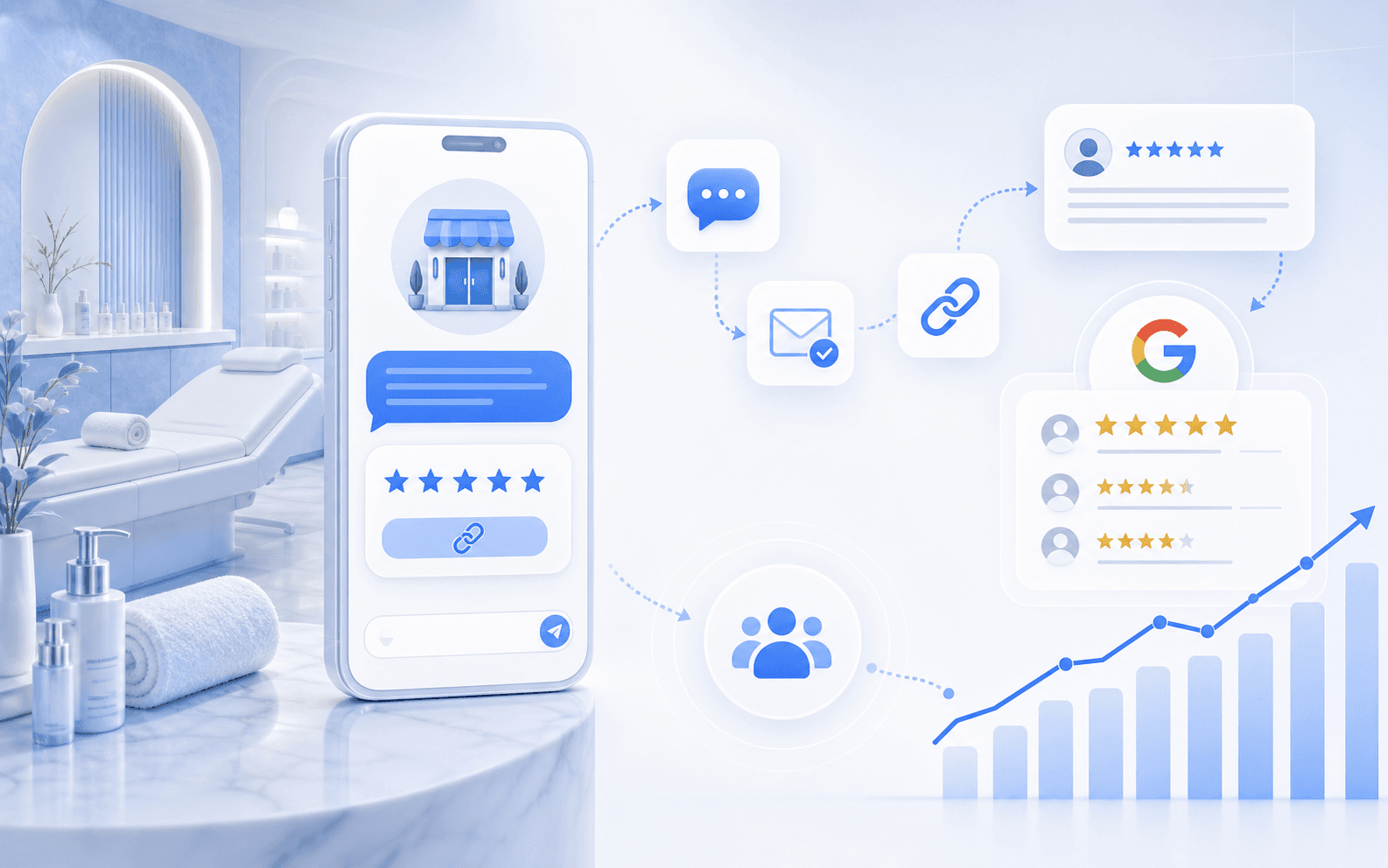
Google Maps is often the first trust checkpoint for local healthcare decisions.
If your clinic is not visible there, patients are more likely to choose the businesses that appear above you.
If you want more Google reviews for a med spa, the answer is not to ask louder. It is to ask better. The med spas that improve review volume most consistently usually build a simple request system around timing, staff confidence, and a direct review link that removes friction.
That matters because med spas compete in a trust-heavy local market. A stronger review profile can help with click-through, local selection, and booking confidence before a prospect ever fills out a form. But the process has to stay compliant, calm, and easy for staff to repeat.
Guide overview
Use this guide to work through the most important fixes
Why reviews matter for med spa visibility
Reviews do more than make a profile look active. They influence whether a med spa feels trustworthy enough to book, especially when nearby compet...
The safest time and channel to ask
The best time to ask is usually right after a positive visit or follow-up, when the experience is still fresh and the request feels natural.
Staff scripts and review request workflow
Most review systems break at the staff level, not at the strategy level. Everyone agrees reviews matter, but if the front desk and provider team...
The short version is this: med spas get more useful Google reviews by building a simple post-visit request workflow, using a direct review link, training staff on neutral asks, and avoiding pressure, incentives, or privacy mistakes.
If you want the fastest operational starting point, use the Google Review Link Generator. It gives the team one clean destination to share instead of improvising the workflow every time.
Why reviews matter for med spa visibility
Reviews do more than make a profile look active. They influence whether a med spa feels trustworthy enough to book, especially when nearby competitors offer similar services and pricing is not the only factor.
In recurring med spa and clinic review work, one of the most common problems is not that the business has zero reviews. It is that the review profile is inconsistent: long quiet gaps, no staff workflow, and no clear follow-up process after a positive visit.
That creates two problems:
- the listing looks less active than nearby competitors
- the business misses easy trust-building moments after satisfied visits
Reviews also help answer a practical question for prospects: do people like me trust this place enough to buy? That is why volume alone is not the goal. What matters is believable momentum and a review profile that supports selection in the local market.
The safest time and channel to ask
The best time to ask is usually right after a positive visit or follow-up, when the experience is still fresh and the request feels natural.
That does not mean every appointment should trigger the same robotic script. It means the team should know the safest points to use a neutral ask:
- after a clearly positive visit
- in a post-appointment message when communication consent already exists
- in a thank-you follow-up that is already part of the client workflow
- after a service recovery moment that ended well
The best channels are the ones clients already use with the business. For some med spas that is SMS. For others it is email or a front-desk follow-up card with a review QR code or direct link.
One recurring issue we see is that med spas ask in bursts when the owner gets focused on reviews, then stop for weeks. A lighter, repeatable weekly rhythm almost always works better than occasional hard pushes.
Staff scripts and review request workflow
Most review systems break at the staff level, not at the strategy level. Everyone agrees reviews matter, but if the front desk and provider team do not know what to say, the workflow never becomes reliable.
A safe request should sound neutral and respectful:
- "If your visit went well, we would appreciate a Google review. I can send you the direct link."
- "We would love your feedback if you have a minute. Here is the easiest place to leave it."
- "If you would like to share your experience, this link goes straight to our Google review page."
The follow-up process should be just as simple:
- send one direct review link
- use plain language
- avoid emotional pressure
- keep follow-up light and limited
In practice, the best med spa workflows usually look like this:
- staff knows when to make the ask
- the business uses one canonical review link
- management can see whether requests are actually being sent
- monthly review momentum gets monitored, not just total count
That is where Curex-style review workflow setup helps. It turns "we should ask more often" into an actual operating process.
What to avoid with privacy and policy
This is the section med spas should take seriously. Review growth is not worth privacy mistakes or manipulative tactics.
Avoid:
- offering incentives for reviews
- filtering only "happy" clients into public review requests
- pushing clients to mention sensitive treatment details
- sending repeated requests that feel aggressive
- improvising requests without clear communication consent
A common med spa mistake is assuming that because reviews matter, any request tactic is acceptable. It is not. The best long-term systems are boring in the right way: clear, polite, compliant, and easy to repeat.
Google's own review guidance supports asking all customers for feedback, but not pressuring them or trying to game the system. That is a much better long-term approach than review chasing built around short-term spikes.
How to make the review link easier to use
Even strong scripts underperform if the destination is messy.
That is why the direct link matters. If the business keeps sending people to the homepage, the map listing, or a confusing search result, a lot of good intent disappears before the review is ever written.
Use one simple link everywhere:
- staff text follow-ups
- email follow-ups
- front-desk QR cards
- internal SOPs
If different team members are sending different destinations, you are creating avoidable friction. That is exactly the kind of operational mistake that shows up again and again in med spa review systems.
The Google Review Link Generator helps solve that problem by giving the team one reliable URL to use.
What review growth should look like in practice
Healthy review growth rarely looks dramatic. It usually looks steady.
A med spa does not need to flood the profile with asks. It needs to create enough consistency that the review profile keeps moving:
- more recent reviews
- fewer long dead zones
- a better balance between review count and nearby competitors
- more confidence that every satisfied client can easily leave feedback
In recurring local SEO work, we often see the best improvement after simple process changes rather than flashy campaigns. A direct link, a cleaner staff script, and one predictable follow-up touch can outperform a much more complicated system.
How Curex fits into the workflow
The strongest review workflows usually combine three things:
- one clean review destination
- staff-ready language
- a local visibility system that ties reviews back to the wider SEO picture
That is why the Google Review Link Generator matters. It simplifies the operational part. And if review growth needs to connect to a larger local visibility plan, Medical SEO Services can support the rest of the clinic growth system too.
If your med spa is also trying to improve map visibility and local discovery, review growth should sit inside that broader framework rather than live as a one-off tactic.
Final takeaway
Med spas get more Google reviews when the ask is simple, timely, and repeatable.
That usually means:
If you want to make the process easier immediately, start with the Google Review Link Generator. Then build the rest of the workflow around consistency instead of pressure. If the med spa needs broader local growth support too, review Medical SEO Services.
Ask these first
- asking after a positive visit
- using one direct review link
- training staff on neutral language
- avoiding incentives and privacy mistakes
- measuring consistency, not just total review count
Methodology for How to Get More Google Reviews for a Med Spa
Last reviewed May 5, 2026This article is grounded in reviewed guidance, local SEO workflows, and the source material linked below.
Sources
Frequently Asked Questions About How to Get More Google Reviews for a Med Spa
The safest time is right after a positive visit or follow-up, when the experience is fresh and the client can respond without feeling pressured.
Yes, if the client has consented to text communication and the message stays neutral, privacy-safe, and easy to ignore if they prefer not to respond.
Avoid incentives, review gating, privacy mistakes, and scripts that pressure clients or ask only happy patients to review publicly.

Next step for clinic reputation
Turn this review guidance into a stronger patient trust workflow
Choose the next action that helps your clinic improve review generation, clean up reputation blind spots, and strengthen the signals patients see before they book.
- Review growth workflows that fit healthcare teams
- Clear next actions for reputation improvement
- Built to support local trust and conversion
Continue learning
Related Resources for How to Get More Google Reviews for a Med Spa
Use these supporting resources to go deeper into the topic cluster without losing the thread of what you just learned.
Related Curex resources
Practical resources to keep moving
Foundational guides, tools, and service paths that support the next stage of implementation.
More from this topic
Continue exploring this cluster
Supporting reads that deepen the same topic without competing with the main CTA above.