
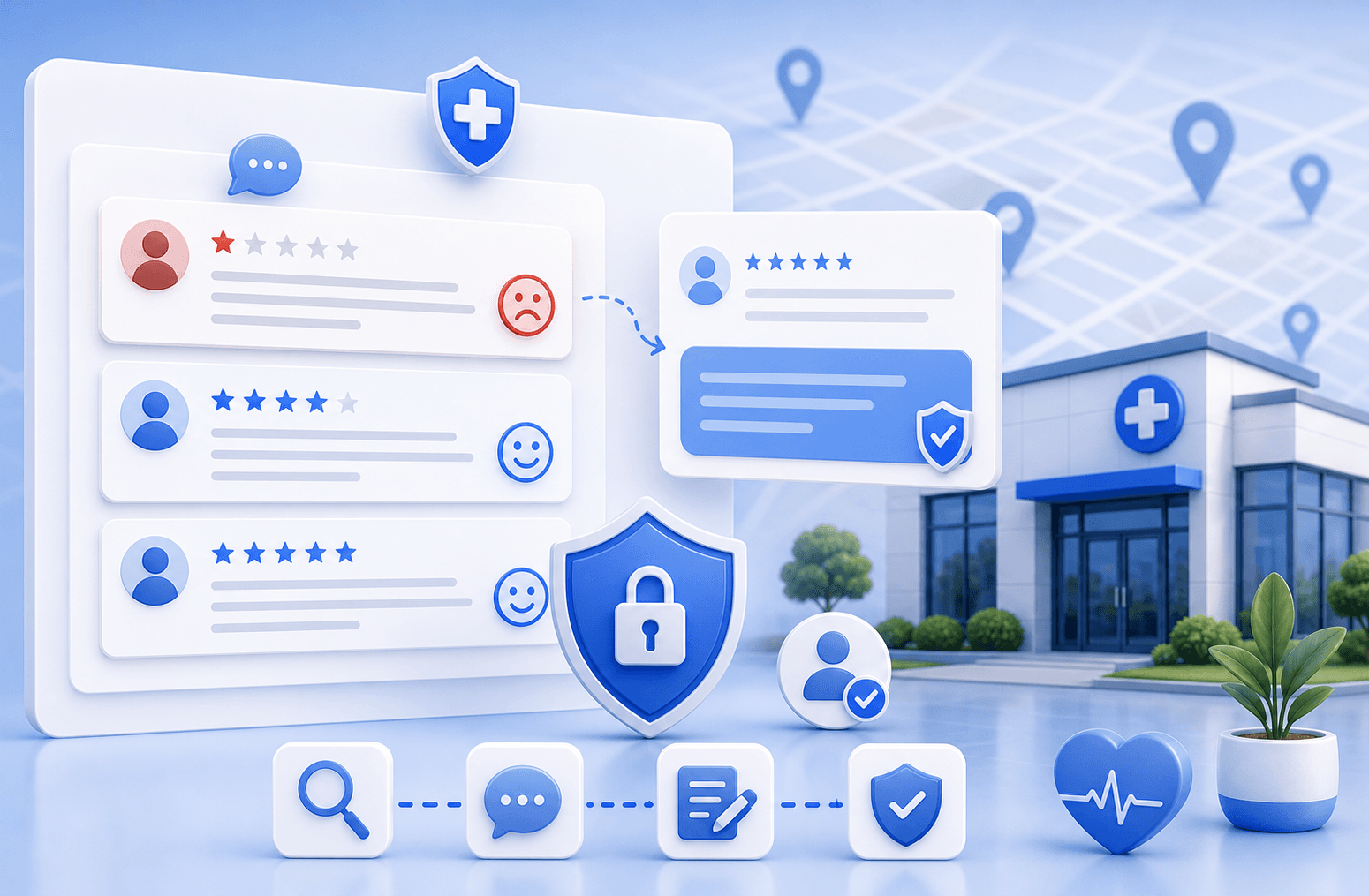
Google Maps is often the first trust checkpoint for local healthcare decisions.
If your clinic is not visible there, patients are more likely to choose the businesses that appear above you.
Responding to a negative review is already delicate for most businesses. For clinics, it is even more sensitive because the response has to protect trust without exposing private patient details or sounding defensive.
That is why the best clinic review response is usually calm, brief, and operational rather than argumentative. The goal is not to win a public debate. It is to show professionalism, preserve privacy, and move the conversation into a safer channel.
Guide overview
Use this guide to work through the most important fixes
Why this matters for clinics
Negative reviews affect more than reputation. They also shape local trust and how comfortable prospective patients feel choosing the clinic.
What to check first
Before making tool or strategy decisions, review the local visibility system in this order:
Step-by-step workflow Curex recommends
Curex usually recommends a simple privacy-first review workflow for clinics and medical practices.
Many clinics get into trouble by trying to explain too much in public. In healthcare, that instinct often creates more risk than reassurance.
Why this matters for clinics
Negative reviews affect more than reputation. They also shape local trust and how comfortable prospective patients feel choosing the clinic.
But clinics have less room for public detail than most businesses do. In recurring review workflow work, one of the biggest mistakes we see is that a clinic tries to defend itself with specifics that feel natural internally but are too revealing publicly.
The safest review-response workflow is one that protects patient privacy, signals professionalism, and gives the team a clear escalation path when the situation is more serious than a routine complaint.
The strongest teams usually evaluate this through a small set of operating questions:
- whether the response can stay privacy-safe without discussing the patient's care publicly
- whether the tone is calm enough to support trust even if the review feels unfair
- whether the clinic has a standard escalation path for sensitive or complex review situations
- whether the team is responding in a way that future patients can interpret positively
What to check first
Before making tool or strategy decisions, review the local visibility system in this order:
- Pause before responding and decide whether the message can stay generic and privacy-safe.
- Identify whether the review is a service complaint, a misunderstanding, or a higher-risk issue that needs internal escalation.
- Write for the future patient reading the exchange, not only for the reviewer.
- Offer an offline follow-up path instead of debating details publicly.
A review response is part reputation management and part risk management. The response should make the clinic look trustworthy without turning into a public case discussion.
Step-by-step workflow Curex recommends
Curex usually recommends a simple privacy-first review workflow for clinics and medical practices.
1Step 1: Acknowledge the concern without confirming sensitive details+
Use neutral language that shows the clinic takes feedback seriously without confirming treatment, timelines, diagnoses, or personal information.
2Step 2: Move the conversation into a private channel quickly+
The response should encourage the reviewer to contact the clinic directly so the issue can be reviewed in the appropriate setting.
3Step 3: Use the review as a trust signal for future patients+
The public response should still show empathy, professionalism, and process discipline. This is one reason broader medical SEO services and reputation workflows matter beyond the review itself.
Common mistakes to avoid
Mistake 1: Trying to correct the patient publicly
Even if the review feels unfair, a defensive or overly specific response often makes the clinic look riskier, not more trustworthy.
Mistake 2: Confirming details that should remain private
Publicly addressing appointments, treatment details, or private facts can create unnecessary exposure and erode confidence.
Mistake 3: Using the same response template for every situation
Consistency is good, but clinics still need an escalation path for more sensitive or complex issues.
When to use Curex tools or services
What to do next
Choose the right Curex path for the issue
Start here
Start with Medical SEO Services
Use the scan when you need a quick read on whether the issue is visibility, listings consistency, or overall clinic SEO weakness.
ContinueOngoing optimization
Get Review Link
Use software-led workflows when the listing is live but the clinic needs stronger control over GBP updates, local signals, and monitoring.
ContinueHigh-risk cleanup
Medical SEO Services
Use the reinstatement path when suspension, verification failure, or policy-sensitive cleanup is part of the problem.
ContinueUse the Google review link generator and broader review workflow tools when the clinic wants a steadier positive-review pipeline to reduce the impact of isolated negative feedback.
Use medical SEO services when review trust is part of a larger visibility and conversion problem. And if the team needs a proactive script for new reviews, connect this workflow with the review request script for medical clinics.
The strongest clinics do not only respond better. They also create stronger systems around review generation and review handling.
Final takeaway
The best way for a clinic to respond to a negative review is to stay calm, stay general, protect privacy, and move the issue offline.
The response should show professionalism, not publish a defense file. In healthcare local SEO, trust is often strengthened more by restraint than by detail.
Methodology for How to Respond to Negative Clinic Reviews Without Violating Privacy
Last reviewed May 11, 2026This article is grounded in reviewed guidance, local SEO workflows, and the source material linked below.

Next step for clinic reputation
Turn this review guidance into a stronger patient trust workflow
Choose the next action that helps your clinic improve review generation, clean up reputation blind spots, and strengthen the signals patients see before they book.
- Review growth workflows that fit healthcare teams
- Clear next actions for reputation improvement
- Built to support local trust and conversion
Continue learning
Related Resources for How to Respond to Negative Clinic Reviews Without Violating Privacy
Use these supporting resources to go deeper into the topic cluster without losing the thread of what you just learned.
Related Curex resources
Practical resources to keep moving
Foundational guides, tools, and service paths that support the next stage of implementation.
More from this topic
Continue exploring this cluster
Supporting reads that deepen the same topic without competing with the main CTA above.