
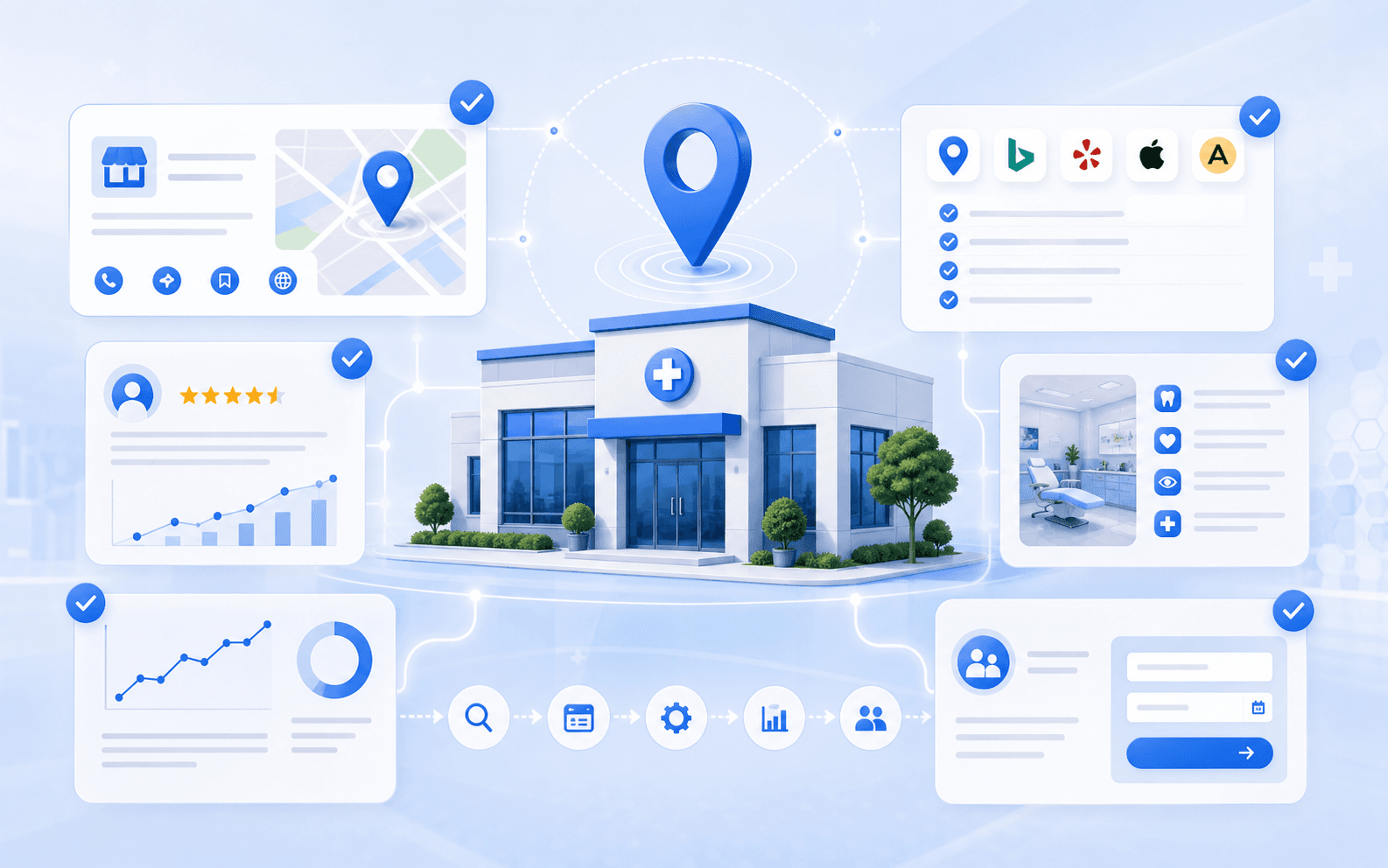
Google Maps is often the first trust checkpoint for local healthcare decisions.
If your clinic is not visible there, patients are more likely to choose the businesses that appear above you.
If you are evaluating medical SEO services, the first thing to understand is that a useful clinic SEO program is not just "content plus backlinks." For most clinics, the work that actually moves visibility and patient acquisition starts with local trust signals, Google Business Profile performance, service-page quality, review strength, listings consistency, and lead-conversion readiness.
That is where many clinic owners get stuck. They are sold a broad SEO package that sounds impressive on paper, but the actual work does not line up with how local visibility grows for clinics, med spas, dental offices, or specialty practices.
Guide overview
What you'll work through in this guide
What clinics think medical SEO includes vs what actually drives visibility
Many clinics hear "medical SEO" and assume it mostly means blog writing, technical cleanup, and ranking reports. Those things can matter, but the...
The non-negotiable deliverables for local clinic growth
If a clinic is paying for medical SEO services, these are the deliverables that should be clearly included or deliberately scoped.
What weak or generic SEO packages usually miss
A generic package often sounds complete because it lists a lot of activity:
The short version is this: a real medical SEO service should help a clinic improve how it appears, how it gets chosen, and what happens after a visitor lands on the site.
If the service does not clearly cover local visibility, website relevance, trust signals, and conversion systems, it is probably too generic.
If you want a faster baseline before comparing providers, start with the free clinic SEO scan. It helps show whether the bigger problems are in GBP, listings, reviews, service-page depth, or the website itself.
What clinics think medical SEO includes vs what actually drives visibility
Many clinics hear "medical SEO" and assume it mostly means blog writing, technical cleanup, and ranking reports. Those things can matter, but they are rarely the whole story for a local clinic trying to generate real patient demand.
What usually drives results first is more operational:
- whether the clinic is visible in local search and Maps
- whether service and specialty pages match the real search intent
- whether reviews support trust and local selection
- whether citations and listings are consistent
- whether the site turns traffic into calls, forms, or booked appointments
In recurring clinic visibility work, one of the biggest disconnects we see is that the SEO retainer is aimed at abstract ranking goals while the clinic still has basic local trust gaps. The reports may look active, but the foundation is not strong enough to support steady local discovery.
That is why a medical SEO service should not begin with generic deliverables. It should begin with the clinic's actual visibility model.
The non-negotiable deliverables for local clinic growth
If a clinic is paying for medical SEO services, these are the deliverables that should be clearly included or deliberately scoped.
1. Google Business Profile and local visibility management
For most clinics, local visibility starts here. A medical SEO service should include a real workflow for:
- GBP optimization
- category alignment
- service and description updates
- change monitoring
- location accuracy
- duplicate/suspension risk awareness
This does not mean every engagement must be a pure GBP service. It means the SEO program should clearly account for the listing layer that supports local discovery.
A clinic that ranks poorly in Maps, has weak categories, or has unresolved profile issues will usually feel that weakness across the whole acquisition system.
2. Service-page and specialty-page strategy
Clinic SEO often underperforms because the website is too broad. Pages talk about the practice in general terms, but they do not give Google or the user a strong reason to connect that clinic to specific services in specific places.
A proper medical SEO service should include:
- service-page planning
- page-depth recommendations
- specialty-specific relevance
- internal linking between related services and resources
- local modifiers where appropriate
In practice, we often see clinics paying for SEO while the site still has thin service pages or missing specialty pages. That creates a ceiling: even with better citations and reviews, the site is not sending enough relevance back to the profile or the query set.
3. Citation and listings consistency
Listings still matter, especially for clinics that:
- moved
- rebranded
- changed phone routing
- added providers
- updated suite details
A medical SEO service should include a plan for:
- citation cleanup
- consistency checks
- high-value directory updates
- ongoing listings governance when needed
This is one of the least glamorous parts of the work, but it is still one of the most common sources of local confusion when it is ignored.
4. Review strategy and review visibility
A clinic's review profile affects more than trust after the click. It can shape local selection before the click too.
A real medical SEO service should include:
- review acquisition workflow guidance
- privacy-safe request language
- response strategy
- review monitoring
- competitive review benchmarking
It should not rely on fake reviews, review gating, or shallow volume chasing. The goal is stable trust and stronger local competitiveness, not a short-term cosmetic boost.
5. Reporting that connects visibility to business outcomes
A weak SEO service gives a clinic traffic screenshots and keyword lists.
A stronger one connects:
- ranking visibility
- GBP performance
- landing-page behavior
- leads or conversions
- next-priority actions
That does not mean every clinic needs enterprise analytics on day one. It means the program should show whether visibility improvements are connecting to real patient-acquisition opportunities.
6. Conversion and lead-capture support
SEO traffic is not the finish line.
A medical SEO service should also account for:
- form placement
- call intent
- page clarity
- conversion friction
- chat or follow-up systems
If the clinic earns more visibility but the site is still weak at turning that attention into action, the SEO program is incomplete.
This is where AI chatbot automation and stronger lead-routing support can matter for the right clinic setup.
What weak or generic SEO packages usually miss
A generic package often sounds complete because it lists a lot of activity:
- blog posts
- backlinks
- technical fixes
- monthly reports
- keyword tracking
The problem is not that those items are useless. The problem is that they are often delivered without enough local context.
Here are some of the most common misses.
They do not treat local visibility as the foundation
For clinics, local visibility is often the first real battleground. If the engagement does not clearly cover local SEO fundamentals, the service may be solving the wrong layer first.
They write content without matching clinic search behavior
It is common to see content calendars built around broad topics that sound educational but do not actually support the services, specialties, or local trust signals the clinic needs most.
They ignore the service-page layer
Many agencies talk about SEO strategy while the actual service pages remain too thin to rank or convert.
They separate SEO from the lead system
If no one is thinking about form quality, appointment intent, or the handoff from search to contact, the clinic may never feel the real business value of the work.
They underweight ongoing change control
One recurring issue we see in clinic environments is that profiles, listings, pages, and staff/location details keep changing, but no one owns the visibility impact of those changes. That creates drift, and drift is expensive.
How Curex structures medical SEO around clinics
Curex's approach is built around the reality that most clinics do not need abstract SEO theater. They need a visibility system that makes local trust stronger, improves service-page relevance, and supports better patient acquisition.
That usually means working across:
- GBP and listings
- service-page quality
- review visibility
- local rankings
- conversion readiness
- operational reporting
The exact mix can vary by clinic, but the important part is that the work reflects clinic visibility mechanics, not just a recycled agency checklist.
This is also why medical SEO services should be evaluated as an operating system, not just a writing package.
If you want the broader local foundation behind this, review local SEO for clinics as well. It helps frame where medical SEO overlaps with GBP, citations, rankings, and website conversion.
Should a clinic choose software, service, or both?
This depends on internal capability and complexity.
Software-first may fit when:
- the clinic has an internal team
- the locations are active but manageable
- leadership wants more control over updates and monitoring
- the main need is better visibility management, not full execution support
Managed service may fit when:
- no one internally owns the workflow
- the clinic has multiple moving parts across pages, listings, and reviews
- the site needs coordinated strategy and execution
- the business wants one accountable visibility program
Both can fit when:
- the clinic wants strong execution plus system visibility
- multiple teams need access to performance and operational tracking
- local SEO is important enough to justify both tooling and hands-on support
In real clinic accounts, the right answer is often not "software versus service" in the abstract. It is "what part of the workflow can the clinic reliably own, and what part keeps breaking without outside structure?"
How to evaluate a medical SEO provider before signing
Before you commit, ask questions that expose whether the service is real or decorative.
Ask:
- how do you handle GBP and local visibility for clinics?
- what do you review on service and specialty pages?
- how do you approach citations and listings consistency?
- what review strategy is included?
- how do you measure leads, not just rankings?
- what does month-to-month execution actually include?
- what would you prioritize first for a clinic like ours?
If the answers stay vague, or if every clinic gets the same package regardless of specialty, location complexity, and current visibility state, that is a warning sign.
Final takeaway
Medical SEO services should not be judged by how many SEO buzzwords they include. They should be judged by whether they actually improve clinic visibility, trust, and patient acquisition.
For most clinics, that means the work should clearly cover:
If you want the fastest way to see where the gaps are, start with the free clinic SEO scan. If you already know you need a more complete managed workflow, go straight to Medical SEO Services and review the structure against your clinic's current reality.
Ask these first
- local visibility
- service-page relevance
- citations and listings
- review systems
- conversion support
- reporting tied to action
Methodology for Medical SEO Services: What Should Actually Be Included?
Last reviewed May 5, 2026This article is grounded in reviewed guidance, local SEO workflows, and the source material linked below.
Frequently Asked Questions About Medical SEO Services: What Should Actually Be Included?
Yes. Medical SEO overlaps with general local SEO, but clinics usually need tighter alignment around GBP, service pages, trust signals, review handling, specialty relevance, and patient-conversion paths.
Usually, yes. An active GBP helps, but it does not replace strong service pages, review momentum, citations, reporting, or conversion support.
That depends on internal capability and complexity. Some clinics only need stronger visibility tooling, while others need a managed system that covers execution, reporting, and conversion support.

Next step for local SEO growth
Move from reading to a clinic SEO action plan
Use the next Curex workflow to turn the article into an actionable growth path, whether you need a diagnostic scan, software support, or hands-on SEO help.
- Built for local healthcare visibility
- Clear path from diagnosis to implementation
- Flexible for software-led or service-led execution
Continue learning
Related Resources for Medical SEO Services: What Should Actually Be Included?
Use these supporting resources to go deeper into the topic cluster without losing the thread of what you just learned.
Related Curex resources
Practical resources to keep moving
Foundational guides, tools, and service paths that support the next stage of implementation.
More from this topic
Continue exploring this cluster
Supporting reads that deepen the same topic without competing with the main CTA above.