
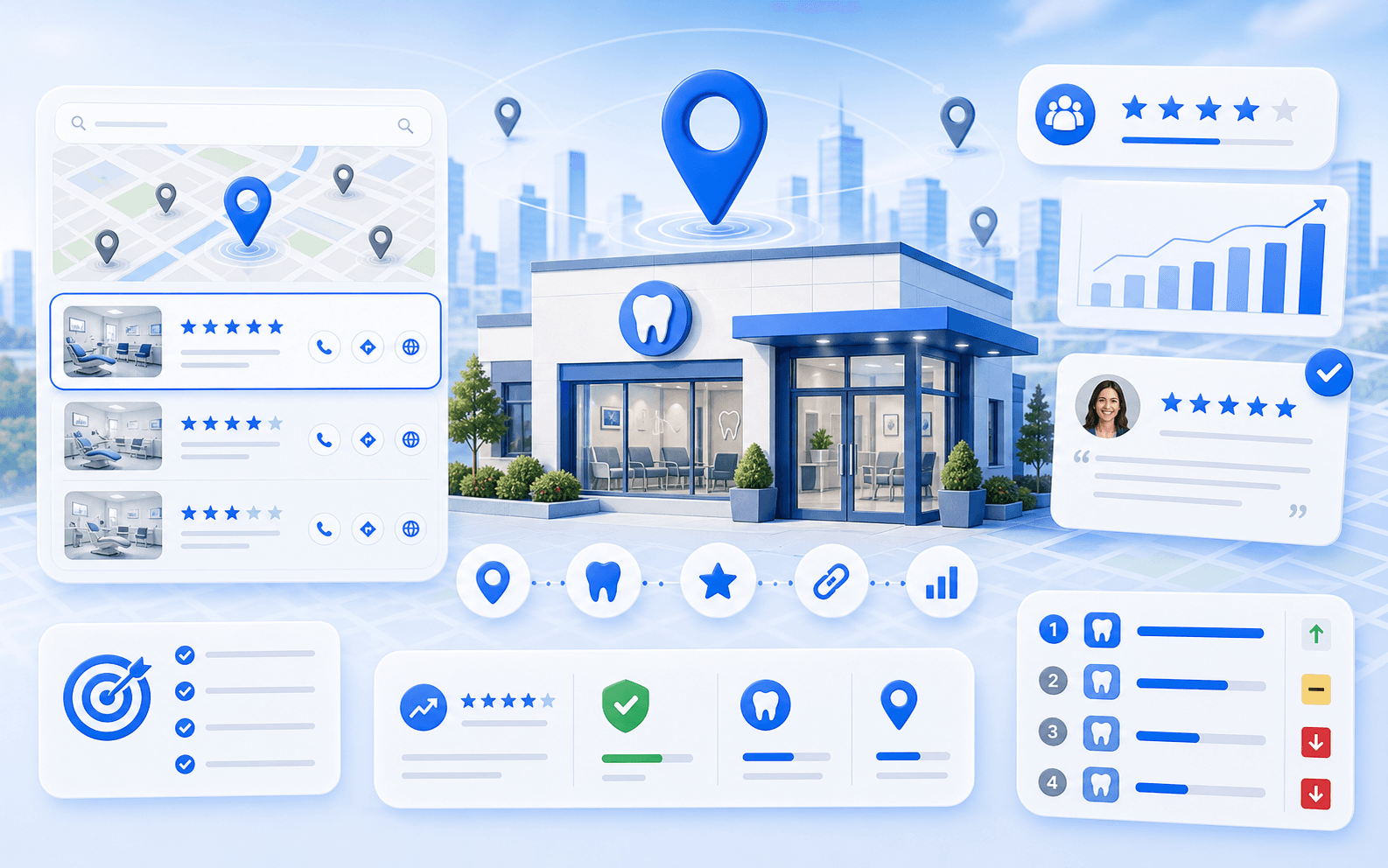
Google Maps is often the first trust checkpoint for local healthcare decisions.
If your clinic is not visible there, patients are more likely to choose the businesses that appear above you.
If you are trying to improve local SEO for a dental practice, the biggest mistake is assuming the answer is one generic checklist. Dental practices compete in a local market where Google Business Profile strength, review quality, service-page depth, location relevance, and competitor density all interact at the same time.
That is why some dentists do almost everything "right" on paper and still struggle to break into the map pack. The problem is usually not one missing trick. It is that one or two of the most important ranking systems are still weaker than the nearby practices that already dominate local selection.
Guide overview
What you'll work through in this guide
The short version is this: local SEO for dentists works best when the practice improves the signals that help Google understand three things clearly:
If you want the quickest visibility baseline before changing anything, start with the local search preview tool and the competitor breakdown tool. They make it easier to separate ranking assumptions from what patients are actually seeing.
Why dental SEO behaves differently from generic local SEO
Dentists often compete in tighter local clusters than many other clinics. There may be multiple providers in the same corridor, the same shopping center, or the same group of nearby ZIP codes. That changes how aggressively every ranking signal gets compared.
For dental practices, local SEO is usually shaped by:
- how well the practice is categorized in Google Business Profile
- whether high-value services are clearly represented on the website
- how review momentum compares with nearby offices
- how strong the practice looks in branded and non-branded searches
- whether location and specialty relevance are obvious enough for Google and for patients
In recurring dental visibility reviews, one of the most common patterns we see is that the practice has a decent profile and some reviews, but the service intent is still too broad. The listing may say "dentist," but the website and category setup do not strongly support higher-value searches like cosmetic dentist, dental implants, Invisalign, or emergency dentistry in the local area.
That is where ranking gaps start to widen.
The ranking factors that usually matter most for dentists
1. Google Business Profile category strength
For most dental practices, Google Business Profile is still one of the strongest local ranking layers. If the primary category is too broad or the supporting categories are weak, the practice may appear for branded searches but lose ground on service-driven queries.
The category setup should reflect the real service focus of the location, not just the broadest label available.
Common issues include:
- using a generic category when the practice has a clear specialty focus
- underusing secondary categories that reinforce real services
- leaving service descriptions thin or outdated
- allowing the profile to drift after provider or treatment changes
If the category layer is weak, the rest of the system often has to work harder just to keep up.
2. Reviews and review quality
Dental practices live or die on trust. Reviews do not only influence conversion after the click. They also affect how competitive the practice looks before the click.
The strongest review signals usually come from:
- consistent new reviews
- strong average rating
- service relevance in the review language
- higher review momentum than nearby competitors
This is where many dentists misread the situation. They assume having "some reviews" is enough, but the real comparison is not against zero. It is against the few practices nearby that have stronger recency, stronger volume, and stronger trust language.
If your review growth is flat while the local leaders keep building momentum, that gap becomes part of the ranking story.
3. Service-page depth and specialty relevance
This is one of the most underweighted ranking factors for dentists.
A practice might offer implants, veneers, sedation, family dentistry, and emergency treatment. But if the site only has a generic home page and one broad "services" page, Google is left with a weaker relevance signal than a competitor whose site has deeper specialty coverage.
Strong dental local SEO usually needs:
- dedicated service pages for the treatments that matter most
- clearer local modifiers where appropriate
- better internal linking between the home page, service pages, and related educational content
- enough page detail to show intent, trust, and conversion readiness
In real dental SEO work, this is often where we find the biggest disconnect: the practice wants to rank for service-specific searches, but the website still reads like a brochure instead of a local treatment destination.
4. Proximity and market density
Proximity still matters, especially in dense dental markets. But proximity is not the same as destiny.
Two practices can be close to the same searcher and still perform very differently because one has:
- stronger categories
- better service relevance
- more trusted reviews
- more complete profile information
- stronger website alignment
That is why "we are closer than they are" is not enough as a ranking explanation. In dental markets, Google often has several nearby eligible practices to choose from. The stronger total signal profile usually wins more visibility.
5. Competitor strength and map-pack maturity
Some dental markets are mature enough that the local leaders are not weak by accident. They have had years to build reviews, strengthen location pages, refine categories, and improve brand familiarity.
That means a newer or less optimized practice should not expect quick gains from surface-level changes alone.
What matters more is identifying where the current leaders are strongest:
- review count and recency
- specialty-specific service pages
- map-pack consistency across neighborhoods
- stronger branded demand
- better profile completeness
This is why competitor comparison matters. If you want to know why another dentist ranks above you, the answer is usually visible in the differences between your profile, your site, and their stronger supporting signals.
What dentists should check first
Before changing anything, review the system in this order.
1Step 1: Search your brand and core services+
Look at:
- exact practice-name search
- "dentist near me"
- your main city + service combination
- specialty terms the practice actually wants to win
This helps separate branded visibility from real local discovery performance.
2Step 2: Compare your reviews against the top three local competitors+
Check:
- total volume
- recency
- rating quality
- whether reviews mention real treatments or outcomes
Many dentists are not far behind on fundamentals, but they are clearly behind on trust momentum.
3Step 3: Review your service-page structure+
Ask:
- do the most important treatments each have a strong destination page?
- is location relevance clear enough?
- are those pages actually linked from important site areas?
- would a patient understand the difference between one service page and another?
4Step 4: Review category and profile completeness+
Confirm:
- primary category strength
- secondary category support
- services listed in GBP
- hours, phone, and website accuracy
- photo freshness
5Step 5: Check whether the practice is being limited by local market density+
This matters because sometimes the practice is not failing. It is simply competing in a much tighter map-pack environment than the owner realizes.
That changes what "good enough" looks like.
Common mistakes dental practices make
The most common local SEO mistakes for dentists are not dramatic. They are usually operational.
Mistake 1: relying on generic dental website pages
If the website does not clearly support the services you want to rank for, local SEO usually stalls.
Mistake 2: treating reviews as passive
Review growth is rarely automatic. The strongest practices usually have a quiet, repeatable review workflow.
Mistake 3: ignoring competitor gap analysis
Many practices optimize in isolation. They improve what they can see internally, but they never compare their profile and site against the offices already winning the local pack.
Mistake 4: expecting GBP tweaks to solve everything
Profile work matters, but if service pages are weak and review momentum is behind, the listing alone will not carry the whole system.
Mistake 5: using one-size-fits-all SEO reporting
Dentists need reporting that connects rankings, review competitiveness, service relevance, and local conversion opportunities, not just keyword screenshots.
When to use Curex tools or services
What to do next
Choose the right Curex path for the issue
Start here
Start with Local SEO For Dentists
Use the scan when you need a quick read on whether the issue is visibility, listings consistency, or overall clinic SEO weakness.
ContinueOngoing optimization
Competitor Breakdown
Use software-led workflows when the listing is live but the clinic needs stronger control over GBP updates, local signals, and monitoring.
ContinueHigh-risk cleanup
Local SEO For Dentists
Use the reinstatement path when suspension, verification failure, or policy-sensitive cleanup is part of the problem.
ContinueUse the local search preview tool if you need a cleaner view of what patients in different areas are actually seeing.
Use the competitor breakdown tool if the main question is why another local practice keeps outranking you.
Use local ranking grids if you need neighborhood-level visibility data instead of broad citywide assumptions.
And if the practice needs a stronger strategic system around rankings, service-page support, reviews, and local visibility, the broader dental and clinic SEO workflow should sit inside the same operating model instead of being handled in disconnected pieces.
Final takeaway
The ranking factors that matter most for dentists are rarely mysterious.
Usually, the biggest local SEO gains come from improving:
If your dental practice is not winning the visibility it should, the answer is usually not one missing trick. It is that a nearby competitor has built a stronger overall local signal profile.
Start by checking what patients actually see, compare the practice against the local leaders, and then work on the weakest ranking layer first instead of trying to improve everything at once.
Ask these first
- category relevance
- review competitiveness
- service-page depth
- profile completeness
- competitor gap awareness
Methodology for Local SEO for Dentists: Ranking Factors That Matter Most
Last reviewed May 6, 2026This article is grounded in reviewed guidance, local SEO workflows, and the source material linked below.
Frequently Asked Questions About Local SEO for Dentists: Ranking Factors That Matter Most
There is usually not one single factor. For dentists, Google Business Profile relevance, reviews, service-page depth, and competitor strength often matter together.
Yes, but if nearby competitors have stronger review momentum and better service relevance, average reviews can still leave the practice behind in local selection.
Most practices should check both together. GBP helps local discovery, but weak service pages and poor local trust signals often limit how far the listing can go.

Next step for local SEO growth
Move from reading to a clinic SEO action plan
Use the next Curex workflow to turn the article into an actionable growth path, whether you need a diagnostic scan, software support, or hands-on SEO help.
- Built for local healthcare visibility
- Clear path from diagnosis to implementation
- Flexible for software-led or service-led execution
Continue learning
Related Resources for Local SEO for Dentists: Ranking Factors That Matter Most
Use these supporting resources to go deeper into the topic cluster without losing the thread of what you just learned.
Related Curex resources
Practical resources to keep moving
Foundational guides, tools, and service paths that support the next stage of implementation.
More from this topic
Continue exploring this cluster
Supporting reads that deepen the same topic without competing with the main CTA above.