
Google Maps is often the first trust checkpoint for local healthcare decisions.
If your clinic is not visible there, patients are more likely to choose the businesses that appear above you.
If you are comparing BrightLocal and Curex for a clinic, the most important question is not which platform has more local SEO widgets. It is whether the workflow actually helps a healthcare business make better visibility decisions.
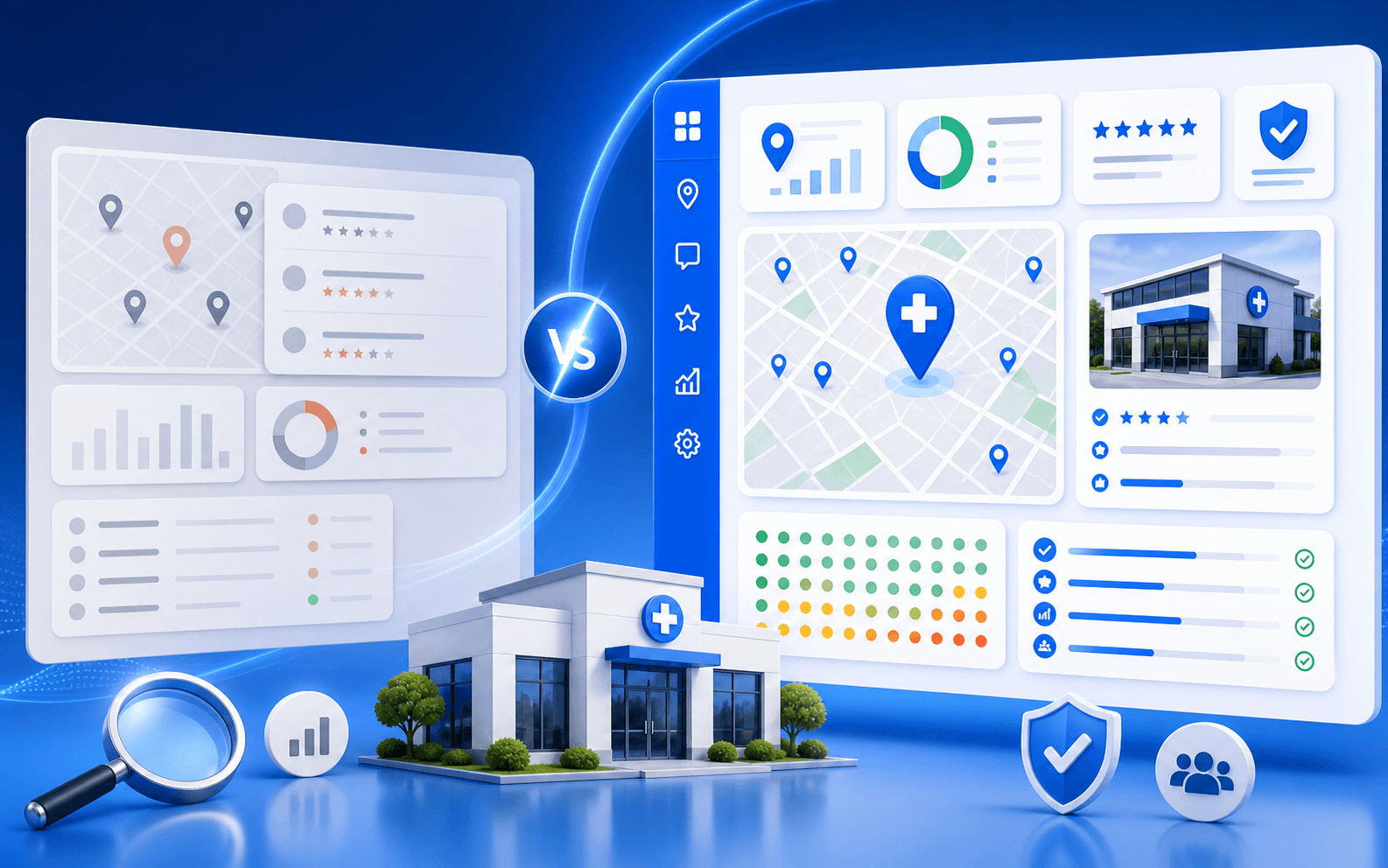
BrightLocal is built as a broad local SEO platform. Curex is built around clinic visibility, map-pack coverage, review trust, citation control, and service-line relevance. That difference matters because most clinics do not lose local rankings for generic reasons. They lose because their Google Business Profile, service pages, review growth, and competitor gaps are not being interpreted in a healthcare-specific way.
Guide overview
What you'll work through in this guide
Why this matters for clinics
Many clinic owners get trapped in a reporting loop. They can see rankings, citations, and reviews, but the tool still leaves them guessing about...
What to check first
Before making tool or strategy decisions, review the local visibility system in this order:
Step-by-step workflow Curex recommends
When Curex evaluates this type of decision with a clinic, the workflow usually looks less like a software demo and more like an operating review.
So the short answer is this: if your team wants a general local SEO reporting platform, BrightLocal can still be useful. If you want a clinic-specific operating system for local growth, Curex usually creates a clearer path from diagnosis to action.
Why this matters for clinics
Many clinic owners get trapped in a reporting loop. They can see rankings, citations, and reviews, but the tool still leaves them guessing about what to fix first.
In recurring clinic reviews, we often see teams spending time on broad local SEO dashboards while the real blockers are things like weak specialty pages, provider-location confusion, hidden review stagnation, or neighborhood-level map-pack gaps that are never translated into a concrete priority list.
That is why the comparison should not stop at feature counts. It should focus on whether the platform helps the clinic understand patient-facing visibility, operational ownership, and competitor pressure in the markets that actually matter.
The strongest teams usually evaluate this through a small set of operating questions:
- whether the platform shows neighborhood-level visibility instead of one average rank
- whether competitor comparisons translate into actions for GBP, service pages, reviews, and citations
- whether clinic teams can use the data without needing a separate analyst to interpret it
- whether the workflow supports healthcare-specific trust, privacy, and multi-location issues
What to check first
Before making tool or strategy decisions, review the local visibility system in this order:
- List the exact local decisions your team needs to make every month: ranking diagnostics, competitor review checks, location-page improvements, or citation cleanup.
- Compare how each platform handles map-pack visibility by neighborhood, not just citywide averages.
- Review whether the reporting helps a clinic owner decide what to fix first, instead of dumping disconnected metrics.
- Check whether the platform supports the service lines and operational workflows that matter in healthcare, such as multi-provider profiles, review handling, and local trust analysis.
If the answer is mostly "we can see the data, but we still do not know what to do next," then the platform is probably giving you visibility reporting without enough healthcare decision support.
Step-by-step workflow Curex recommends
When Curex evaluates this type of decision with a clinic, the workflow usually looks less like a software demo and more like an operating review.
1Step 1: Benchmark the clinic's map-pack visibility where patients actually search+
Start with local ranking grids and a live local search preview tool check. That gives the team a more honest view of how often the clinic shows up across neighborhoods, not just in one idealized location.
2Step 2: Layer competitor pressure on top of those rankings+
Use the competitor breakdown tool to compare review momentum, category strength, page depth, and local trust positioning. In clinic markets, rankings rarely move for one isolated reason.
3Step 3: Translate the visibility gap into a clinic operating plan+
The valuable output is not the report itself. It is the decision order: fix category conflicts, deepen service pages, improve review flow, or clean citation drift. Curex tends to be stronger when the team needs that action-oriented layer instead of a generic reporting dashboard.
Common mistakes to avoid
Mistake 1: Choosing on feature quantity instead of operating fit
A broader local SEO feature list does not automatically make the tool better for a clinic. Many healthcare teams need fewer dashboards and more clarity.
Mistake 2: Treating all local businesses the same
Clinic visibility is shaped by service intent, review trust, privacy-sensitive workflows, and provider-location complexity. A platform that treats the clinic like any storefront may leave critical gaps unaddressed.
Mistake 3: Using rankings as the only success metric
Clinics also need to know whether the rankings map to actual patient demand, better service-page relevance, and higher-confidence conversion paths.
When to use Curex tools or services
What to do next
Choose the right Curex path for the issue
Start here
Start with Local Ranking Grids
Use the scan when you need a quick read on whether the issue is visibility, listings consistency, or overall clinic SEO weakness.
ContinueOngoing optimization
Competitor Breakdown
Use software-led workflows when the listing is live but the clinic needs stronger control over GBP updates, local signals, and monitoring.
ContinueHigh-risk cleanup
Pricing
Use the reinstatement path when suspension, verification failure, or policy-sensitive cleanup is part of the problem.
ContinueUse Curex when the team needs a more clinic-specific local workflow around rankings, competitor gaps, review trust, citations, and location visibility instead of generic local reporting alone.
Use local ranking grids when the biggest question is map-pack coverage. Use the competitor breakdown tool when the real need is to understand why another clinic keeps outranking you. If the clinic still needs a broader visibility baseline first, start with the local search preview tool.
Those tools work best together because they move the team from seeing rankings to understanding why those rankings look the way they do.
Final takeaway
BrightLocal and Curex are not trying to solve the exact same problem. BrightLocal is a broader local SEO platform. Curex is stronger when a clinic needs a healthcare-specific visibility workflow that turns rankings, competitor signals, and service relevance into a practical action plan.
If the clinic keeps getting reports but still does not know what to fix next, that is usually the sign to choose the system that is closer to operations than to generic dashboarding.
Methodology for BrightLocal vs Curex for Clinic Local SEO
Last reviewed May 11, 2026This article is grounded in reviewed guidance, local SEO workflows, and the source material linked below.

Next step for local SEO growth
Move from reading to a clinic SEO action plan
Use the next Curex workflow to turn the article into an actionable growth path, whether you need a diagnostic scan, software support, or hands-on SEO help.
- Built for local healthcare visibility
- Clear path from diagnosis to implementation
- Flexible for software-led or service-led execution
Continue learning
Related Resources for BrightLocal vs Curex for Clinic Local SEO
Use these supporting resources to go deeper into the topic cluster without losing the thread of what you just learned.
Related Curex resources
Practical resources to keep moving
Foundational guides, tools, and service paths that support the next stage of implementation.
More from this topic
Continue exploring this cluster
Supporting reads that deepen the same topic without competing with the main CTA above.